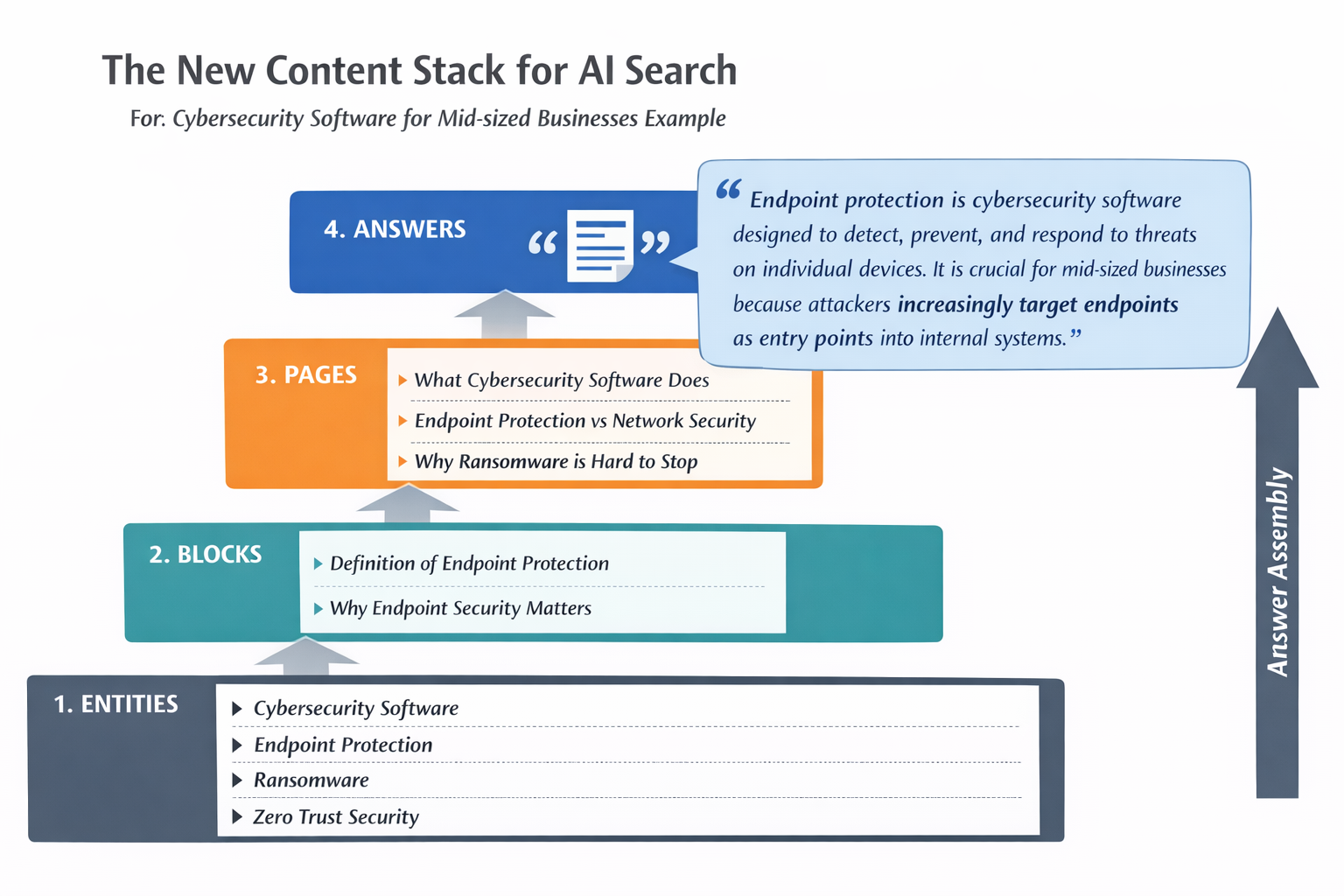
The New Content Stack for AI Search: Pages, Blocks, Entities, and Answers
A Practical Walk-Through Using a Real Category
At some point, every discussion about AI search hits the same wall.
Teams understand that answers matter more than pages.
They accept that clarity beats volume.
They agree that atomic content is the future.
And then someone asks the only question that matters.
“What does this actually look like in practice?”
So let’s stop abstracting.
Let’s walk one category all the way through the modern content stack and show exactly how pages, blocks, entities, and answers work together in the real world.
The Category We Will Use
Cybersecurity software for mid-sized businesses
Why this category works:
- It is crowded
- It is jargon-heavy
- Buyers are confused
- Advice is repetitive
- AI search already answers many questions directly
In other words, it is perfect.
Step 1: Entities — What the System Needs to Understand
In a traditional SEO model, planning might start with keywords like:
- cybersecurity software
- endpoint protection
- ransomware prevention
- zero-trust security
In the modern stack, we start one level higher.
We ask: What entities must the system understand clearly for this category to make sense?
Core entities might include:
- Cybersecurity software
- Endpoint protection
- Ransomware
- Zero-trust security
- Managed detection and response
- Mid-sized business security needs
These are not pages yet. They are objects of understanding.
If these entities are poorly defined or inconsistently explained, no amount of optimization will produce answer selection.
Step 2: Blocks — Turning Entities Into Usable Explanations
Now we create atomic blocks tied to each entity.
Let’s take just one.
Entity: Endpoint Protection
A weak block might say:
“Endpoint protection is an important part of a cybersecurity strategy that helps protect devices from threats.”
A strong, answer-ready block says:
“Endpoint protection is cybersecurity software designed to detect, prevent, and respond to threats on individual devices such as laptops, desktops, and servers. It matters because attackers increasingly target endpoints as the fastest path into internal systems.”
That block:
- Names the entity
- Defines it
- Explains why it exists
- Resolves ambiguity
It can now be reused.
Step 3: Pages — Organizing Blocks for Humans
Now we design pages, but with discipline.
Instead of one bloated page titled “Cybersecurity Solutions,” we build pages that organize blocks around one core question.
Examples:
Page 1: What Cybersecurity Software Actually Does for Mid-Sized Businesses
Includes blocks on:
- Definition of cybersecurity software
- Why mid-sized businesses are targeted
- Common misconceptions
- What security software does not solve
Page 2: Endpoint Protection vs Network Security
Includes blocks on:
- Endpoint protection definition
- Network security definition
- How they differ
- When each matters
Page 3: Why Ransomware Is Harder to Stop Than Most Teams Expect
Includes blocks on:
- Ransomware definition
- Common failure modes
- Why traditional tools fail
- How modern protection works
Each page is useful on its own.
Each block inside it is usable independently.
Step 4: Reinforcement Across Pages
This is where the stack compounds.
The exact same endpoint protection block appears:
- In a comparison article
- In a ransomware explainer
- In a glossary
- In a buyer guide
The language does not drift.
The definition does not change.
The explanation remains stable.
To a machine, this looks like confidence.
Step 5: Answers — What the System Builds From This
Now imagine a user asks an AI search tool:
“What is endpoint protection and why does it matter for mid-sized businesses?”
The system:
- Identifies the entity
- Finds repeated, consistent blocks
- Selects language that resolves the question
- Assembles an answer
If your content:
- Defines the entity clearly
- Explains why it matters
- Reinforces the explanation across contexts
Your language becomes the answer.
Not your page.
Your explanation.
What the Old Page-First Model Would Have Done
Let’s contrast this.
A page-first model would likely produce:
- A long “Endpoint Protection Software” page
- Multiple keyword variations
- Inconsistent phrasing
- Definitions buried mid-page
It might rank.
But when the system needs a clean, quotable explanation, it struggles to extract one.
Ranking without selection is common.
Selection without ranking is increasingly normal.
Why This Works Better for Zero-Click Search
Zero-click environments demand clarity upfront.
Atomic blocks:
- Surface definitions early
- Resolve questions directly
- Reduce the need for navigation
- Lower cognitive load
That is exactly what answer engines are optimized to deliver.
The Strategic Insight Most Teams Miss
The breakthrough is this:
You are not building pages for users.
You are building explanations for systems that serve users.
Pages are delivery mechanisms.
Blocks are the product.
How This Changes Content Planning Immediately
Instead of planning:
“What pages do we need next quarter?”
You plan:
“What explanations must exist for our category to be understood correctly?”
Instead of auditing:
Page performance
You audit:
- Definition clarity
- Language consistency
- Concept reinforcement
This is a different discipline.
Why Smaller Content Libraries Now Win
Once this stack is in place:
- Every new page reinforces existing entities
- Authority compounds instead of dilutes
- Content scales without sprawl
This is why newer, more focused sites often outperform older, larger ones in AI answers.
They teach more clearly.
Summary: The Stack Only Makes Sense When You See It End to End
Pages still matter.
But they are no longer the center of gravity.
Entities define meaning.
Blocks create usability.
Pages organize for humans.
Answers are the outcome.
When you design content this way, AI search stops feeling opaque. You can see the logic.
And once you can see it, you can design for it.